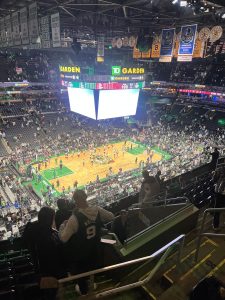
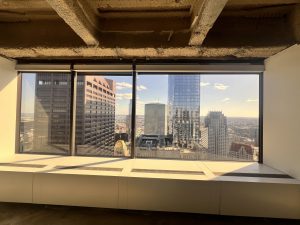
March in Boston as an architect
 [activecampaign form=264]
 Benjamin Hall Design redefines accessory housing in Arizona with concrete block architecture
Carol Bove at the Guggenheim
The skyscraper that is redefining Vancouver, inspired by glass marine reefs
Hockey Time!
Introduction
As a big sports fan in brazil, one of my goals while enjoying this experience in the USA was to get in touch with their sports as well. So, after experiencing an NFL Football game in the Jacksonville stadium, I decided to try Hockey this time.How the game works
Since it was my first time watching a hockey game, I needed some explanation before getting there. And, from what I understood, it's similar to soccer. To the extent of having two teams play against each other by trying to aim the object of play into the opponent's goal. In soccer, it is a ball, but in Hockey, they use the puck. What differs is that in a hockey game, they maneuver the puck with another object, a hockey stick.Experience
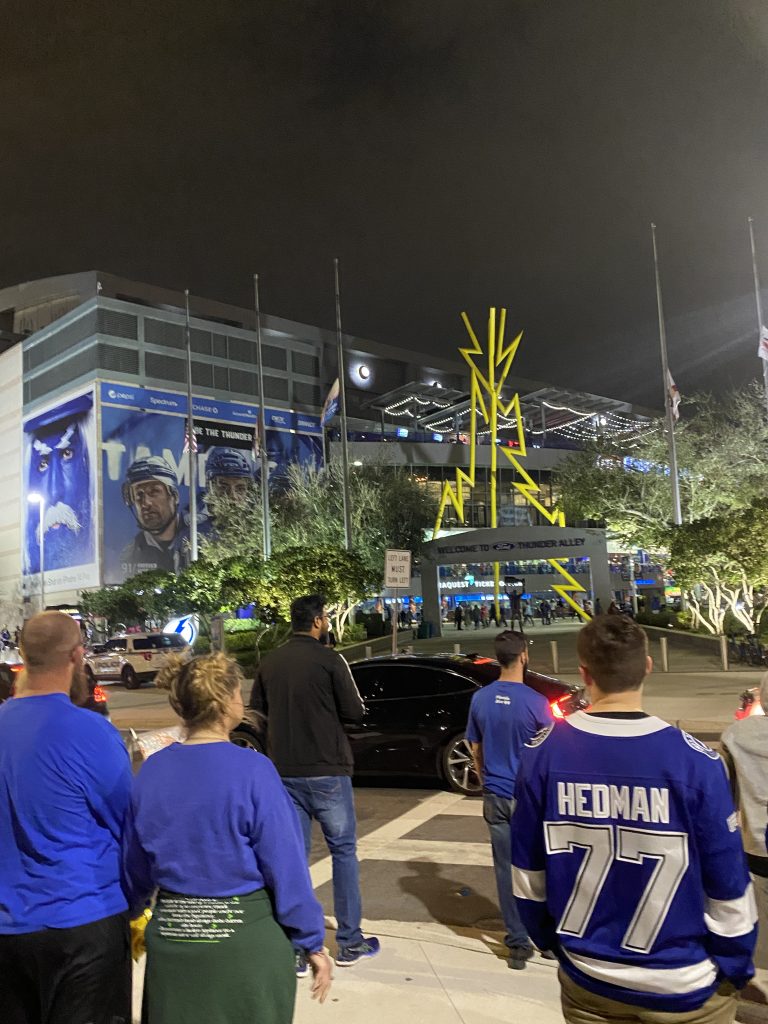
I had the opportunity to go to a hockey game in Tampa last Tuesday. The hometown team, Tampa Lightning, played against Minnesota Wilds at Amelia Arena. The first quarter was tough; they were even most of the time. However, the second one was full of goals for both sides. And the third one was when Tampa could open two goals of advantage by the end of the game and guarantee victory. Some players fought during the game, especially when the opposing team hit their goalie, but nothing too serious. The crowd went crazy with it, and it was funny to watch it. Personally, I am not a big fan of fights, but it's allowed inside the game until an instance, and the guys over there seemed used to it.Space
Amelia Arena is gorgeous. As a multipurpose arena, it hosts activities such as ice hockey, basketball, football, concerts, and other events. The project started in 1996 with Ellerbe Becket as the responsible architect: at the time, they called it "Ice Palace." Check it out if you are in the downtown Tampa area; it's worth it.Conclusion
As one of the most fun activities I've done so far, I recommend the experience. Even if you were like me, someone who had no idea how this sport worked before seeing it. The crowd is fun to be around, and the game itself is dynamic and exciting; easy to get the rules as long as they play. From now on, I know that I'll watch it more often; it's fun!
 [activecampaign form=266]
 My first month in New York: a cultural escape
The MOMA: an immersion in modern art
The first museum I visited was the Museum of Modern Art. It felt wonderful to walk through the galleries filled with paintings, photographs, and sculptures from different periods. I was especially surprised by the number of architecture exhibits: hand drawings, photographs, and even architectural models were displayed in the gallery; I was happy to find pieces of Mies van der Rohe's work that I have been studying in class.
I went to MoMA knowing that I would finally see one of my favorite paintings: The Starry Night by Van Gogh. Many people were standing around, quietly admiring its beauty. I stayed there for a long time, staring at the swirling sky and vibrant colors, which seemed even brighter and more alive in real life.
The Museum of Natural History: a travel in time
A week later, I stepped into a completely different universe at the American Museum of Natural History. From the present-day living world to dinosaurs and the birth of galaxies, it felt like traveling through millions of years in just a few hours.
The first moment that amazed me was walking into the hall of ocean life and seeing the enormous blue whale suspended from the ceiling. I had seen pictures of it before, but seeing it in person was a completely different experience. Then I walked through the dinosaurs galleries. Just like the blue whale, their size was overwhelming. It was fascinating to imagine how these incredible creatures once lived and how they evolved into the animals we know today. I also attended a planetarium show about the creation of our galaxy. The images were breathtaking, and the story of the Milky Way was beautifully narrated by actor Pedro Pascal.
This first month in New York has already been filled with discovery and wonder. If this is just the beginning, I can’t wait to see what is next.
[activecampaign form=264]
St Patrick's Day Holiday
The celebration
For those who don't know, St. Patrick's Day is on March 17th, an Irish holiday that America embraced due to the number of Irish descendants that built this nation. According to my brief research, some cities with an expressive number of Irish immigrants, who often exert political power, staged the most extensive celebrations, which included elaborate parades. For instance, the first St. Patrick's Day parade was held by Boston in 1737, followed by New York City in 1762. Since 1962 Chicago has colored its river green to mark the holiday. Irish and non-Irish alike typically join the party in the "wearing of the green"—wearing a piece of cloth of green or a shamrock - the Irish national plant - in the lapel. In addition, some traditional dishes as corned beef or even cabbage, are identified as part of the holiday. Finally, the beer is sometimes dyed green to celebrate the day. Even though some of these practices were eventually adopted by the Irish themselves, the reason at the beginning was mainly for the benefit of tourists.The story
St. Patrick is well-known as the patron saint of Ireland. He was born in Roman Britain in the late 4th century, he was kidnapped at 16 and taken to Ireland as an enslaved person. He escaped but returned about 432 CE to convert the Irish to Christianity. By his death on March 17th, 461, he had established monasteries, churches, and schools. Many legends grew around him—for example, he drove the snakes out of Ireland and used the shamrock to explain the Trinity. Ireland came to celebrate his day with religious services and feasts.My personal experience
I could celebrate the holiday over Jacksonville beach. We were all trying to dress anything green and went to an Irish bar; we could enjoy some Celtic songs over there, which was nice. Unlikely last year, when the holiday ended up being on a weekend that we celebrated the entire day, this one was a Friday night, which was also excellent but shorter than the previous year. It's a fun holiday anyway; I recommend everyone to join it! [activecampaign form=264]Austin breaks ground on its new convention center, designed by LMN and Page
J-1 Visa Internship Experience: Preparing for San Diego
My J-1 Visa Internship Experience: Preparing for San Diego
An overview of myself...
My name is Isabel, I’m Spanish,and this is my J-1 visa internship experience as I prepare to move from Madrid to the United States. I’m currently studying a Master’s in Industrial Engineering in Madrid. I’m the eldest of five siblings, so I’ve always been used to living in a busy, lively environment, and I think that has made me very independent, responsible and adaptable.
I would describe myself as a very curious and ambitious person, but also very personal and family-oriented. Outside of university, one of the things I love most is music. I’ve always enjoyed it a lot, and it’s a big part of who I am. I also enjoy sports, meeting new people, and saying yes to experiences that challenge me and help me grow.
Getting started and general concernes...
Before starting this process, I was mainly worried that the visa application would take a long time or be more complicated than expected. At first, all the paperwork seemed a bit overwhelming, but once I started going through it step by step, it felt much more manageable.
I heard about the program searching for a way to live and exciting and enriching international experience. The process was incredibly well guided, everything was clearly explained, and whenever I had doubts, I felt supported, which made the whole experience much less stressful.
Embassy appointment experience...
My Embassy appointment went well and was actually much quicker than I had imagined. My main advice would be to bring all your documents well organized, arrive early, and stay calm. The interview was short and straightforward, so being prepared and confident really helps. Also, do not forget to leave your laptops at home!!!
In a nutshell, a great opportunity...
I got the opportunity through my academic and professional path, but what excites me most about this experience is not only the work itself — it’s everything that comes with living in the U.S. I’m looking forward to growing as a person, becoming even more independent, discovering a new culture from the inside, and learning from a completely different environment.
For me, the American experience is not just about going abroad. It’s about challenging myself, opening my mind, and making memories that I know will stay with me for a lifetime.
I will keep you updated and tell you about my adventures!
Here are some links for your interest:
Home Page - BridgeUSABridgeUSA
Isabel.
[activecampaign form=266]
Chicago will open the Obama Presidential Center in Jackson Park on June 19, 2026.
Balancing Practice, Licensure, and Growth in the U.S.
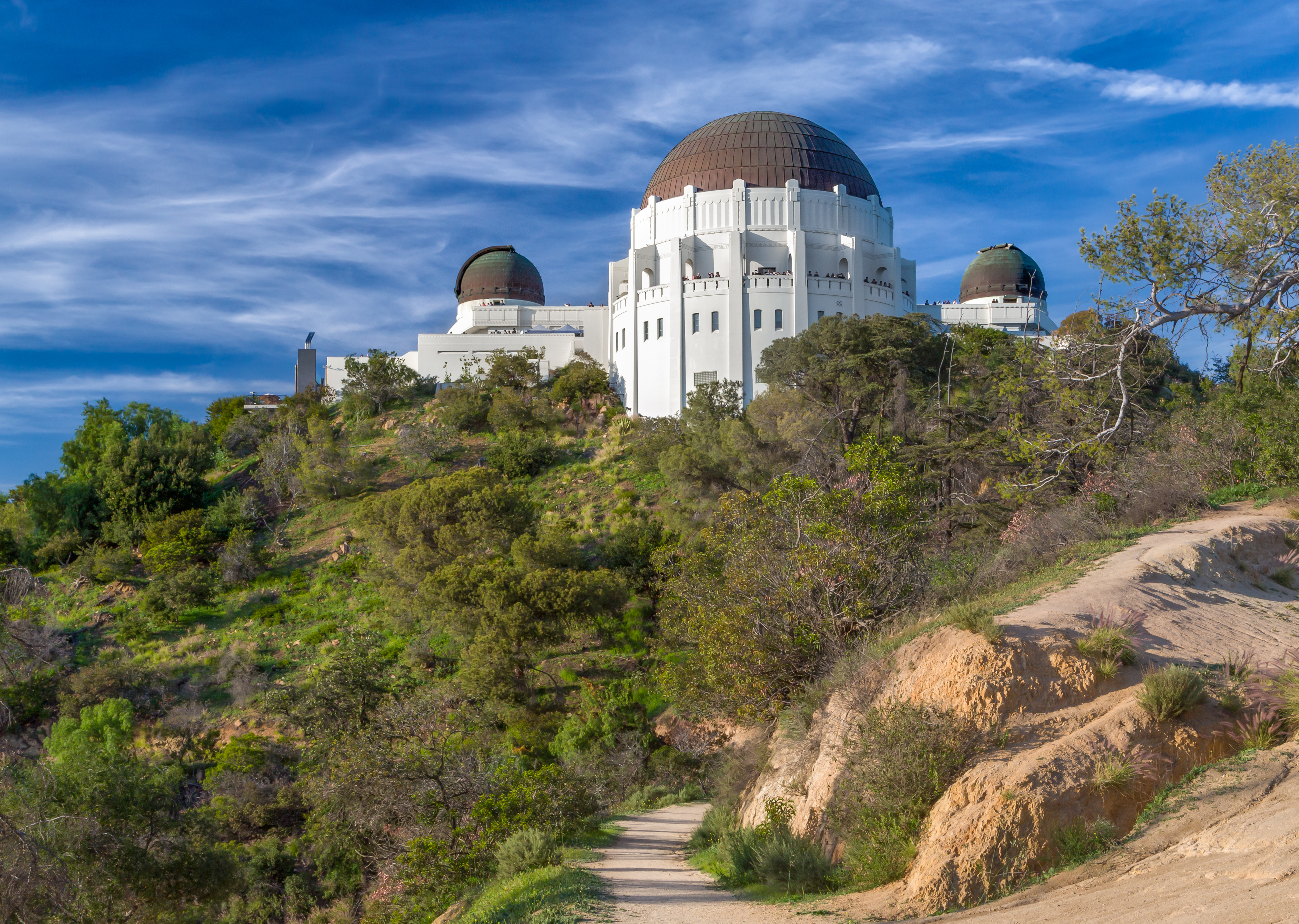 Historic Griffith Observatory in the Hollywood Hills of Los Angeles, California.[/caption]
Preparing for the NCARB licensure process while working full time at SENER Los Angeles has been one of the most challenging and rewarding parts of my experience in the United States. What initially felt overwhelming gradually became an opportunity to truly understand what it means to grow as an architect in a global and competitive market.
Studying for licensure while actively participating in real projects has given me a deeper perspective on architecture. Theory and practice constantly intersect, and each day at work reinforces what I’m learning for the exams. In many ways, the NCARB licensure process has helped me see architecture not only as a creative discipline, but also as a profession built on responsibility, standards, and long-term commitment.
Professional Practice and the NCARB Licensure Process
Working at SENER has allowed me to experience firsthand how large-scale projects are managed in the U.S. market. Collaboration, coordination, and clearly defined processes play a key role in every stage of development. At the same time, preparing for the NCARB licensure process has made me more aware of the technical, ethical, and regulatory aspects that shape architectural practice in the United States.
Balancing both paths requires discipline and consistency. There are long days, tight schedules, and moments of doubt. However, this combination has strengthened my confidence and clarified my professional goals. As a result, understanding how licensure aligns with daily practice has made the process feel purposeful rather than abstract.
Understanding the Business Side of Architecture in the U.S.
Beyond design and technical skills, one of the most valuable discoveries has been learning how architecture firms operate as businesses in the U.S. market. Being exposed to discussions about project management, business development, and firm growth has expanded my understanding of what it takes to build and sustain an architectural practice.
Moreover, observing how new companies emerge, how teams position themselves in the market, and how strategy influences design decisions has been eye-opening. Architecture in the United States is deeply connected to entrepreneurship, and understanding this connection has helped me identify new possibilities for my own professional future.
Reflections on Growth and Direction
Looking back, I realize that this phase has been about much more than exams or professional experience. It has been about learning how to balance ambition with patience, effort with resilience, and goals with adaptability. Preparing for the NCARB licensure process while working at SENER has taught me that growth often happens when we challenge ourselves on multiple levels at once.
If there’s one lesson this journey continues to teach me, it’s this: professional growth is not linear, but every step even the difficult ones builds a stronger foundation for the future.
[activecampaign form=264]
February in Boston: Snow, Studio Growth and New Experiences
February in Boston has truly felt like a classic New England winter. It has been snowing frequently, transforming the city into a white landscape that feels almost cinematic. As someone coming from a different climate, experiencing such intense snowfall has been both beautiful and challenging. The rhythm of the city changes with the weather — streets become quieter, movements slower, and architecture feels even more present against the white backdrop.
Professionally, this month has been very productive. At Fogarty Finger, I have been working on office projects both in Boston and in New York. It has been exciting to contribute to projects in two cities with such distinct urban identities. Boston’s historic fabric and New York’s density create very different design conversations, and being exposed to both contexts has allowed me to broaden my understanding of workplace design in the United States.
One of the most exciting developments this month has been the growth of our team. The office is expanding, welcoming new architects and designers, which brings fresh energy and new perspectives into the studio. It is inspiring to be part of a growing team where collaboration and exchange of ideas are constant. As an international architect on a J1 visa, being included in this dynamic environment makes the experience even more meaningful.
Beyond work, I have been embracing winter activities and the cultural life of the city. I even went ice skating — something I had rarely done before — which felt like a true Boston experience. Despite the cold, the city remains active and vibrant, with exhibitions, events, and gatherings that make winter feel alive rather than restrictive.
February has been a month of adaptation and growth: adapting to the snow, growing professionally within a dynamic office, and continuing to immerse myself in American culture. Each month here reinforces how valuable this international experience is, both personally and professionally.
I look forward to what the next season will bring.
 Processed with VSCO with b5 preset[/caption]

Adrian Smith + Gordon Gill design a yacht-inspired skyscraper on the Miami waterfront
Giving back to the Community
Empathy as a designing core value
Hi Architect-US crew, In this blog post, I want to dive deep into one of the biggest discoveries I have made since working at Wheeler & Kearns Architects in Chicago. As soon as I hear from the Architect-US team that I was going to have an interview with them, I started to search and read about this office, its work, and its mission. I had some previous experience doing other internships at different offices, but none can compare to this one. Even though their focus wasn’t mainly residential, I never came upon an office that had non-profit projects as one of their pillars. When I first started my internship here in Chicago, I was introduced to this hybrid way of working. Combining very high-end housing with the need of giving back to the community. This balance has been without any doubt the most fulfilling experience I have ever had since I came to the US. The care and empathy that are shown in any of these non-profit projects have totally blown my mind. On top of that, it has given a deeper meaning to what an architect is able to do and give back. I have been lucky enough to start working on one of these projects, and the level of awareness when designing is something I have never experienced before. I can´t stress enough how grateful I feel for being able to be part of such a team and exposed to so many learning experiences. The moment when you see that what you design in your Revit model transcends the screen and actually makes an impact in other people’s lives is just unmatched. Despite being aware during college that design helps people, this is the first time that I have experienced it first-hand. As a result, I feel a whole new level of purpose in my career that I wouldn’t have without this experience. [activecampaign form=264]Safdie Architects designs a residential tower in Florida with restrained, sculptural architecture
Starting my internship journey in New York
What brings me there
As part of my studies, I am completing two internships this year in order to gain experience in structural design. I just finished my first six-month internship in Paris three weeks ago, and in just a few days I will be starting a new internship in New York, which will be a great opportunity for me to grow both professionally and personally.The visa application process
Once I was told that I had been selected as an intern at GMS, I immediately started applying for a J-1 visa. My main concern about the visa process was the potential delay. Because of the dates of my internship, I had only two months to complete the entire process, which felt like a risky bet. Fortunately, everything went very smoothly. I was nervous about all the paperwork but Architect-US took care of it very effectively. Then it was time for me to schedule my embassy appointment. I realised quickly there was nothing to worry about : my appointment lasted no more than 2 minutes and the delivery of my passport afterwards was extremely fast.Living a new life in NYC
I am now ready to move to New York. It is a brand new experience for me: I have never travelled so far and have always lived with my family. Starting a new life in a new city is a bit scary, but it is also very exciting. I am really looking forward to see New York. It is a city that has always fascinated me, and I am so happy to be able to experiment its energy with my own eyes. I am already looking forward to exploring the city and everything it has to offer, and meeting people to share experiences with. [activecampaign form=266]Design Alliance Architects designs a sculptural concrete chapel in Missouri
Next Stop New York: My Final Countdown Before Joining DS+R
Hi reader!
As a J1 visa architect in New York, I am just a few days away from getting on a plane to start my adventure at Diller Scofidio + Renfro. It still feels strange to put it into words. Soon I will cross the Queensboro Bridge instead of the M‑30. I will trade my usual commute in Madrid for the Manhattan skyline and subway lines I still need to learn by heart.
How it all started
First, this journey began months ago, when I decided it was the right moment to challenge myself and look for an experience abroad. To start, I polished my portfolio with the help of Architect‑US. Then they sent it to several studios in the U.S. on my behalf. Thanks to their support, I had four interviews with offices in both New York and Los Angeles. During each conversation, a different future appeared in front of me: new cities, new ways of working, and new versions of myself as an architect. As a result, I felt excited, but I was also a bit overwhelmed by all these possible paths.
Getting the call
However, deep down I always knew where my compass was pointing. New York was the city that had been in my head for years, and DS+R was the studio whose projects I had been following and admiring from afar. One day, Pati called me to tell me that they wanted me to join the team. At that moment, everything suddenly aligned. My dream studio was in my dream city, and they had chosen me. I don’t think I will ever forget that phone call.
Planning my new life
Right now, my days are a mix of packing boxes, saying goodbye, and checking lists of documents. For my first three months I will be living in Astoria, Queens, in a neighborhood that people describe as lively, diverse, and full of small restaurants to discover. After that, my plan is to move closer to the Columbia area. This way I can experience a different side of the city and shorten my commute to the office. Step by step, I hope to get to know New York through its neighborhoods instead of only through the typical postcards.
Looking ahead
Of course, there are still many unknowns ahead of me, and I am sure that not everything will go as planned. However, this uncertainty is also part of the reason why I am doing this. I want to learn how a studio like DS+R thinks, designs, and builds, and how the city influences the projects. I also want to feel what it is like to be part of that energy every day. Finally, this blog will be my way of documenting the journey: the first days at the office, the cultural shocks, the small victories, and all the moments in between. If you are also dreaming about taking a similar step, I hope my experience shows you that it is possible – and that sometimes the risk is exactly what makes it worth it.
[activecampaign form=264]When Friends Become Family in New York
Living in New York changes the way you understand relationships. Distance, time zones, and busy schedules slowly rearrange the idea of family. Without planning it, friends begin to take on that role.
Over time, this city teaches you to build closeness intentionally. Shared routines replace inherited ones. Celebrations are planned around availability rather than tradition. Ordinary moments like cooking together, walking home late, or meeting after work become anchors. New York doesn’t slow down to accommodate you. You adapt within it.
What makes this shift possible is the city itself. Its density, connectivity, and constant movement create opportunities for repeated encounters. You see the same people often enough for familiarity to grow naturally. Neighborhoods become extensions of social life. Certain streets, cafés, or subway lines start to feel shared rather than anonymous.
The city doesn’t make relationships easier, but it makes them frequent. That frequency matters. It allows friendships to deepen not through intensity, but through consistency. Over time, those patterns form something close to family.
From an architectural perspective, this is where New York becomes interesting. The city is not just a backdrop, but an active structure that supports social proximity. Its scale encourages overlap. Its infrastructure enables access. Its public spaces allow relationships to exist beyond private interiors.
Friends becoming family is not a dramatic moment. It happens gradually, almost quietly. One invitation turns into routine. One familiar face turns into a constant presence. The city keeps moving, but your circle stabilizes within it.
New York is often described as overwhelming or impersonal. Yet, living here has shown me the opposite. Within its complexity, the city allows new forms of belonging to emerge.
In a place where almost everyone arrives from somewhere else, family is something you build.
[activecampaign form=264]
SOM moves forward with 400 Lake Shore on the former site of the Chicago Spire
Cloisters in NY
EHDD completes the decarbonized renovation of the AIA Global Campus in Washington
First Broadway Show
Before moving to New York, Broadway was never something that truly caught my attention. Not because I didn’t value it, but because I assumed it simply wasn’t for me. I’ve never been particularly drawn to classic musicals or large theatrical productions, and in my mind, Broadway belonged to a different kind of audience.
After living in the city for a while, however, I started feeling a quiet obligation to go. How could I live in New York and never experience Broadway at least once? It felt like one of those things you are supposed to do here, whether or not you think it fits your interests. So when I finally went to see The Book of Mormon, it was more out of curiosity and a sense of “I should” than genuine excitement.
I was completely wrong.
What surprised me wasn’t just how funny the show was, but how intelligent, self aware, and carefully constructed the entire experience felt. The performance balanced humor, critique, music, and storytelling in a way that felt contemporary rather than traditional. It didn’t rely on grandeur alone. It was intentional, confident, and sharp.
Walking out of the theater, I realized that my resistance hadn’t really been about Broadway itself, but about my own assumptions. Much like architecture, theater is often reduced to categories that limit our willingness to engage. We decide something is not for us before we ever experience it.
As an architect, I am constantly reminded that space, culture, and design cannot be fully understood from the outside. They require participation. That night, Broadway became another layer of New York that I had unintentionally closed myself off from.
Living in New York and being part of Architect-US has pushed me to reconsider not only my professional boundaries, but my personal ones as well. Sometimes, the experiences that end up shaping you the most are the ones you almost skip.
[activecampaign form=264]
Canstruction Houston: Where Design, Teamwork, and Purpose Meet
When I arrived at the company I heard about something that immediately caught my attention: Canstruction.
Canstruction Houston took place on November 8 at the Houston Convention Center, and if you’re wondering what it’s all about, here’s the short version:
Canstruction is an annual event where architecture and engineering firms, consultants, and partners come together to design and build large-scale structures entirely out of canned food. Once the exhibition is over, all the cans are donated to local food banks. Design with a purpose, literally.
But the process is what makes it special.
It all started back in the office, where ideas began to fly. Teams brainstormed shapes, themes, and characters we wanted to build. After several discussions (and a lot of excitement), our team decided on a Dragon Ball–inspired structure: a baby dragon holding the Dragon Ball. Fun, nostalgic, and visually strong.
Once the concept was set, roles naturally formed. We had:
-
A 3D model designer, who helped us understand quantities and placement of cans
-
Team members in charge of ordering and logistics
-
And someone to design and build the presentation board explaining the concept
That last part was on me. It took a few days of focused work, but seeing it come together , and later standing next to the final structure, was incredibly rewarding.
Then came build day.
The team and our partners arrived early in the morning, armed with snacks and beverages, fully convinced it was going to be a long day. Spoiler alert: it wasn’t. With good coordination and teamwork, the structure was completed that same morning.
Walking around the exhibition was honestly inspiring. The level of effort and creativity was impressive. There were massive and detailed structures:
-
A can-made Taj Mahal
-
A whimsical Alice in Wonderland scene
-
A huge Stitch
-
A Labubu figure
-
An adorable Snoopy and his house
-
Even a Buc-ee’s
My personal favorite? A 1950s-style go-kart. The body was made of silver sardine cans, and the wheels were cleverly formed using bags of red beans. It was thoughtful, playful, and beautifully executed.
Each structure had its own story, and behind every one of them was a team collaborating under pressure, but with a lot more laughter.
The exhibition stayed open for a few days while the jury evaluated the entries and selected winners. But honestly, what I loved most wasn’t the competition.
It was the reason behind it all.
In Houston alone, Canstruction events collect tens of thousands of cans every year, which are then donated to fight food insecurity in the community. It’s an incredible way to bring designers and architects into a cause that goes far beyond aesthetics.
Designing to help others. Building to give back.
I truly believe initiatives like this should be replicated in more places around the world. It proves that creativity, teamwork, and social impact can coexist — and that architecture doesn’t always start with concrete and steel. Sometimes, it starts with a can.
[activecampaign form=266]
8 Things you can do to earn a 6 figure architecture salary
WEISS/MANFREDI updates its vision for the renovation of the La Brea Tar Pits in Los Angeles
New Projects, New Skills, and a True Boston Winter
Hello everyone!
January has marked a fresh start and an exciting new phase of my experience in Boston. After settling into the office dynamic over the past months, I’ve now been assigned to new projects at Fogarty Finger, which has allowed me to take on more responsibility and continue learning at a faster pace. Being trusted with new tasks has been both motivating and rewarding, and it’s helping me grow more confident in my role within the team.
At the same time, I’ve started a Revit course to strengthen my technical skills and better adapt to the tools used in the U.S. professional environment. Learning Revit more in depth has been challenging but very satisfying, as it’s helping me understand workflows, coordination, and documentation from a new perspective. Little by little, I’m becoming more comfortable with the software and applying what I learn directly to my daily work.
Outside of the office, January has been a month of connection and shared experiences. We organized a potluck dinner with friends from all around the world, each person bringing a dish from their own country. It was a beautiful evening full of conversation, laughter, and cultural exchange, and moments like these have made me feel truly at home despite being far from my own country.
January also brought a true Boston experience: a major snowstorm. Seeing the city covered in snow was impressive and unforgettable. Streets, parks, and buildings transformed overnight, and daily life slowed down in a way I had never experienced before. While the cold was intense, the atmosphere was magical, and it made me appreciate the resilience and rhythm of the city even more.
Overall, January has been a month of growth, learning, and adaptation. Between new professional challenges, technical training, and memorable moments outside of work, I feel grateful for how much I’m learning every day. I’m excited to continue building on this momentum and to see what the coming months will bring.
[activecampaign form=264]
Structure inspired by San Francisco bridges at Super Bowl 60 stadium
A City That Never Shows the Same Face Twice
One of the things I’ve learned about New York is that it never settles. Just when you think you understand it, the city shifts slightly and shows you something new.
Over time, I’ve had several friends and family members come to visit me. Almost instinctively, I take them to many of the same places. Familiar neighborhoods, favorite walks, cafés I already trust, streets I know how to navigate. In theory, I’m repeating the same routes again and again.
Yet somehow, the city never feels repeated.
Each visit unfolds differently. A street I’ve walked dozens of times suddenly feels new because of a conversation happening alongside it. A familiar corner looks different at another hour of the day. A place I thought I knew gains meaning simply because I’m seeing it through someone else’s eyes.
What surprises me most is that even when I’m playing the role of guide, New York continues to surprise me. It finds ways to interrupt my sense of familiarity. A pop up installation appears where there was nothing before. A storefront changes overnight. A quiet block becomes unexpectedly alive. The city refuses to be static, even when my routine is.
As an architect, this constant transformation feels deeply relevant. Cities are not fixed objects. They are living systems shaped by people, time, movement, and perception. New York makes this impossible to ignore. It reminds me that design is not only about form, but about adaptability and experience.
Living here has taught me that repetition does not mean stagnation. You can walk the same streets and still encounter something entirely new. Sometimes, the change is physical. Other times, it’s internal.
New York keeps revealing itself to me in layers. And no matter how many times I think I’ve seen it all, the city always finds a way to prove me wrong.
[activecampaign form=264]